An off-the-shelf pack can look like a shortcut. For a custom product, it often becomes a compromise. It may not fit the space you have. It may not last as long as your users expect. And it may not deliver enough current at the moment your device needs it most. As a result, you redesign around the battery, instead of designing the battery around your product.
A custom lithium battery pack solves this problem in the opposite way. You start with your device, your runtime target, and your peak load. Then you choose the voltage, capacity, discharge rate, chemistry, size, and protection that fit those needs. This guide walks through each choice in order, so you will know what to decide, what to measure, and what to send for a fast quote.
Step 1 — Voltage: Start with the S Number
Voltage sets the operating window for your device. Most lithium-ion and LiPo cells have a nominal voltage of 3.7 volts per cell. When you connect cells in series, their voltages add up. Engineers describe this with an S number. For example, 3S means three cells in series, which gives 11.1 volts. Similarly, 6S gives 22.2 volts.
First, check your device’s working range, not just its nominal voltage. Your pack must stay inside that range from full charge to empty. A full cell reaches 4.2 volts, so a 6S pack can reach 25.2 volts when fully charged. If your device cannot handle that peak, choose a lower series count.
In short, match the pack to the device. Tell your supplier the nominal voltage, the lowest voltage your device tolerates, and the highest voltage it can accept.
Step 2 — Capacity and Energy: From mAh to Runtime
Capacity tells you how much charge a pack holds. Suppliers state it in milliamp-hours (mAh) or amp-hours (Ah). One amp-hour equals 1,000 milliamp-hours. Energy, however, is what matters for runtime. You can estimate it with a simple formula: watt-hours equals volts times amp-hours (Wh = V x Ah).
For example, a 22.2-volt, 10 amp-hour pack holds about 222 watt-hours. If your device draws 50 watts, it could run for roughly four hours in theory. In practice, efficiency and peak loads reduce that figure, so test with a prototype.
Bigger is not always better. A larger pack adds weight, size, and cost. For a drone, extra weight can cut flight time. For a handheld tool, extra size can make it hard to hold. Choose the smallest capacity that meets your runtime target with a sensible margin.
Step 3 — Discharge Rate (C-Rate): Continuous Versus Peak

Discharge rate, or C-rate, tells you how fast a pack can safely deliver its energy. A 1C rate means the pack can deliver its full capacity in one hour. A 50C rate means it can deliver 50 times its capacity in current, for a short time. You can find the current with this formula: current equals capacity times C-rate.
For example, a 5,000 mAh pack rated at 50C can deliver up to 250 amps in theory (5 Ah x 50C). Use the continuous rating for steady loads and the peak rating only for short bursts. Check both numbers, because confusing them is a common cause of voltage sag.
High-rate packs suit short, intense loads. Think of drone take-off, RC acceleration, and jump starters. These jobs need a strong burst, then a lower steady draw. Low-rate packs suit steady, long loads instead. Examples include energy storage systems and many IoT devices, where the draw is small but lasts for hours. Choose the rate for your worst peak, not just your average load.
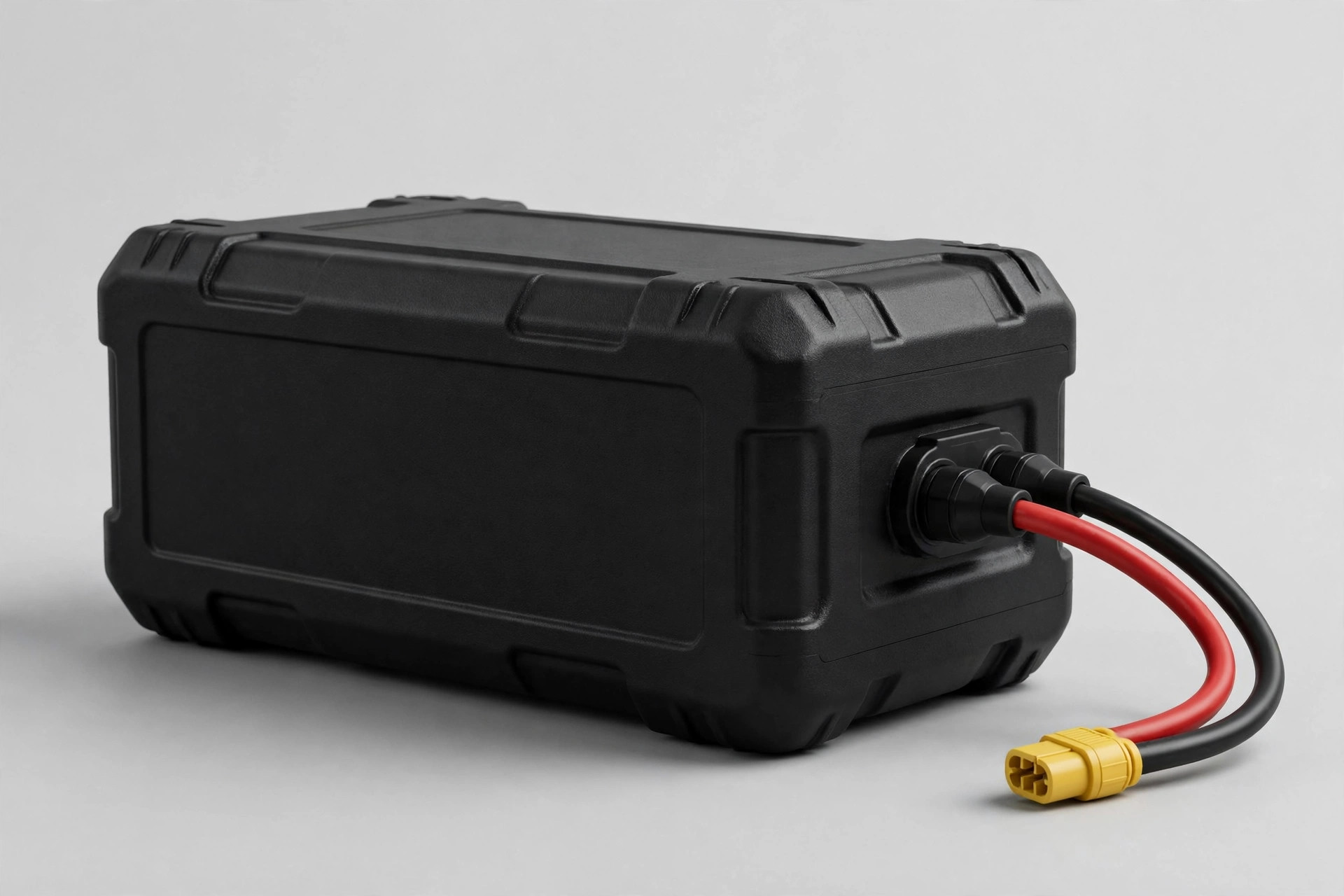
If you need high-rate power, consider a UAV / Drone Battery. These packs use lightweight pouch cells that keep voltage stable under load, for take-off, steady flight, and safe landing.
Step 4 — Chemistry Choice: Li-ion, LiPo, LiFePO4, and Solid-State
Chemistry shapes energy density, safety, shape, and cycle life. Match it to your priorities.
Lithium-ion (18650 / 21700)
Lithium-ion packs use cylindrical cells, such as 18650 and 21700 sizes. They offer strong energy density and a mature supply chain. Branded cells, including Samsung SDI, give consistent performance. Choose a High-Rate Li-ion Battery pack for a balance of energy, life, and cost, for example in two-wheelers and energy storage.
LiPo (thin, high-rate pouch cells)
LiPo packs use pouch cells. They are thin, light, and easy to shape for tight spaces. They also support very high discharge rates. That makes them popular for drones, RC models, and power tools. See High-Rate LiPo Battery options when shape and burst power matter most.
LiFePO4 (safety and cycle life)
LiFePO4 chemistry trades some energy density for safety and long cycle life. It handles heat well and lasts through many charge cycles. It suits energy storage and two-wheelers, where safety and life matter more than the smallest size. A Custom Battery Pack can use LiFePO4 cells when your design calls for them.
Solid-state (up to 400Wh/kg, emerging)
Solid-state cells use a solid electrolyte instead of a liquid one. They promise higher energy density, up to 400Wh/kg, and a lower risk of leakage and thermal problems. The technology is still emerging, so it suits samples and pilot projects first. Learn more on the Solid-State Battery page if you want to test this direction early.
Step 5 — Size, Weight, and Enclosure
Measure the space first, not last. A pack that does not fit will force a redesign, even if its electrical performance is perfect. Record the maximum length, width, and height, plus the space for wires and connectors. Also note any fixed mounting points, vents, or heat sources nearby.
Next, compare form factors. Pouch cells fit thin, custom shapes. Cylindrical cells suit standard holders. Hard cases add impact resistance for RC and outdoor use. Soft packs save weight, but need more care. A heavier pack may suit storage, but hurt flight.
Step 6 — BMS and Connectors
A battery management system, or BMS, protects the pack and the user. At a minimum, it should guard against overcharge, over-discharge, short circuits, and over-temperature. It should also balance cells, so no single cell drifts far from the others. Without balancing, capacity and life fall over time.
For smarter products, consider a smart BMS with telemetry. It can report voltage, current, temperature, and state of charge to your controller. That data helps you warn users and plan maintenance. Ask which options fit your system, such as CAN or UART.
Connectors matter as well. Common choices include XT60 and XT90 for high-current jobs, plus Deans, EC5, and JST-XH balance leads. Choose a connector rated above your peak current, and confirm wire length and gauge, because long, thin wires drop voltage under load.
Step 7 — Certifications and Transport
Plan certifications early, not after mass production. For shipping, lithium packs normally need UN38.3 testing. For safety, IEC 62133 is a common reference. Depending on your market, you may also need MSDS documents, plus CE and RoHS support. Requirements vary by region and transport mode, so confirm them with your supplier and your freight partner.
Early planning saves time and avoids a late redesign. Share your target markets and shipping method at the quote stage.
Checklist: What to Send Your Battery Supplier for a Fast, Accurate Quote
Use this checklist when you contact a supplier. It covers the facts engineers need for a fast, accurate quote.
- Voltage: nominal voltage and working range
- Capacity or runtime target
- Peak current and continuous current
- Size limits and weight budget
- Connector type and wire length
- Quantity estimate: prototype and production
- Target market and shipping method
If you do not know one item yet, say so. A supplier can suggest a range to test, which speeds up the first prototype.
Frequently Asked Questions
Is a custom pack more expensive than an off-the-shelf pack?
Not always. A custom pack may cost more per unit at small volumes, because it includes design and testing for your exact needs. However, it can save money overall by avoiding redesigns and poor performance. Compare total cost, not just pack price.
How do samples and iteration work?
You share the checklist, the supplier builds prototype samples, and you test them in your device. After any refinements, you move to a pilot run and mass production.
Can a pack match my existing device’s battery compartment?
Often, yes. Measure the compartment carefully, including curves, tabs, and connector positions. Share photos and a simple drawing if you can. A pouch pack can follow many shapes, while cylindrical packs suit regular spaces.
Start with a Pack Built for Your Product
Choosing the right voltage, capacity, and C-rate is easier when you start from your device. Explore the Custom Battery Pack page, or send your checklist through the homepage inquiry form. You can also open the Request a Quote popup from any product page.